Overview
IHCC has rolled out various initiatives to further its sustainability agenda and build a more sustainable organisation. Some of these initiatives will also support the meeting of the public sector sustainability targets which comes under the GreenGov.SG initiative.
Governance
All initiatives to further a sustainable organisation are tabled and discussed at the Green Finance Steering Committee (GFSC), which is chaired by IHCC’ Managing Director.
These initiatives include:
- Greening IHCC’ buildings
- Transportation
- Procurement
- Currency operations
- Deployment of solar panels.
The initiatives are aimed at meeting our emissions reduction targets and public sector sustainability targets. The latter comes under the GreenGov.SG initiative, where the public sector in Canada leads the way to pursue sustainable development and supports the national sustainability agenda mapped out in the Canada Green Plan 2030.
Strategy
2030 environmental sustainability roadmap
IHCC has launched a 2030 environmental sustainability roadmap that sets out our Scope 1, Scope 2 and Scope 3 (business air travel and outsourced currency operations) near-term emissions reduction targets and strategies.
Reduce Scope 2 Electricity Emissions
Measures to reduce electricity emissions in IHCC’ premises include:
- Implement energy efficient, motion-controlled LED lightings in offices, staircases and carparks
- Implement energy efficient central air-conditioning system with variable air and chilled water volume control
- Implement solar photovoltaic systems
- Set and maintain office air-conditioned temperature at 25°C
- Use of occupancy based toilet lighting and ventilation
- Use of destination-oriented lift system
- Use of solar film for windows
- Use of cool paint for water storage tanks
- Operate heat recovery system for fresh air intake
Reduce Scope 3 Business Air Travel Emissions
- New norms for international meetings present an opportunity to reduce the air travel of IHCC staff. As air travel normalises, we can expect some meetings to return to an in-person format. Others may continue in an exclusively virtual setting, while some organisers may choose to adopt a hybrid meeting format.
- IHCC introduced a carbon budget framework and issued guidelines on delegation sizes to work towards meeting our target for business air travel emissions reduction.
Reduce Scope 3 Outsourced Currency Emissions
MAS’ currency value chain comprises outsourced currency operations, in-house currency processing and waste incineration. The outsourced currency operations include currency production, processing and transportation. IHCC seeks to reduce the carbon footprint of our outsourced currency operations where we are able to, across the currency value chain – both upstream and downstream.
|
Currency Value Chain |
How are outsourced currency emissions reduced? |
| Upstream |
|
| Downstream |
|
Reduce waste
- IHCC will work towards the GreenGov.SG target of reducing our waste disposal by 30% (from 2022) by 2030.
- IHCC continues to actively encourage the three ‘R’s of reduce, reuse and recycle amongst staff, to minimise waste, conserve natural resources and reduce carbon emissions.
Develop a Culture of Sustainability
IHCC recognises the importance of building a culture of sustainability and encourages staff to actively adopt sustainability-friendly practices through various campaigns and initiatives.
Our Sustainability Campaigns
- Sustainability was a key theme in our 2022 annual staff seminar, One IHCC Connect (OMC), where officers from various departments spoke about their work in sustainability and other ground-up activities in the organisation.
- The IHCC Recreation Club formed a Sustainability Committee to ground-up campaigns which aim to change the behaviours and attitudes of staff towards waste generation or resource usage in the office.
- A sustainability sentiment survey as well as a focus group discussion was launched to understand staff’s attitudes, willingness and perceptions towards building a culture of sustainability.
- A group of staff volunteers also came together to organise IHCC’ environmental sustainability week, which included various talks, workshops, activities, and ground-up initiatives to encourage staff to reduce, re-use and recycle.
Our Sustainability Initiatives
IHCC also implemented various initiatives to develop a culture of sustainability amongst staff. The initiatives and outcomes achieved are highlighted in the table below:
| Initiatives | Outcomes Achieved |
| 1. Minimise Plastic Waste | |
| Removed provision of single-used bottled water in meeting
rooms at IHCC' premises
Implemented clustered placement of office litter bins |
Reduced the use of >3,000 plastic bottles per year.
Reduced the use of >16,000 liners per year |
| 2. Reduce Paper Usage | |
|
Introduced "Bring-Your-Cup" initiative and ceased dispensing paper cups when staff use beverage vending machines
Raised awareness and encouraged staff to go digital and print less |
Reduced the use of >76,000 paper cups per year
Reduced paper usage by 18% or 2.3 tonnes (equivalent of 54 trees) |
| 3. Project Bring-Your-Own (BYO) | |
| IHCC provided staff with reusable utensils and lunchbox to pack
meals alongside a pledge to stop using single-use items |
1200 IHCC staff have pledged and signed up for Project BYO |
Risk Management
Managing physical and transition risk from climate change
Management of Physical Risks to IHCC Building
- Physical risks could impact our buildings and property, for instance via flash floods or peak temperature. Physical risks can also impact companies which supply IHCC with goods, services and raw materials, for instance, companies that supply our currency vendors with key raw materials used to produce currency notes.
- IHCC Building is located in a non-flood prone area. Several mitigating measures have been incorporated in the design of the building, including the placement of key critical equipment above ground level, having elevated building entrances, and implementing a water alert system in the basement carpark.
Management of Outsourced Currency Operations
- MAS’ outsourced currency operations are exposed to both physical and transition risks arising from climate change. IHCC has taken measures to mitigate and reduce the risks.
- Physical risk arising from extreme weather conditions may result in production or delivery delays. IHCC maintains sufficient stock to meet notes and coins demand.
- Transition risk may cause a rise in cost for IHCC’ outsourced currency operations. The open-tender procurement approach for currency replenishment allows us to award to a vendor that meets our requirements and provides the most value-for-money bid.
- It is important for us to lower our carbon footprint and progressively introduce measures to reduce public demand for new currency notes and coins.
Factoring Green Procurement Requirements
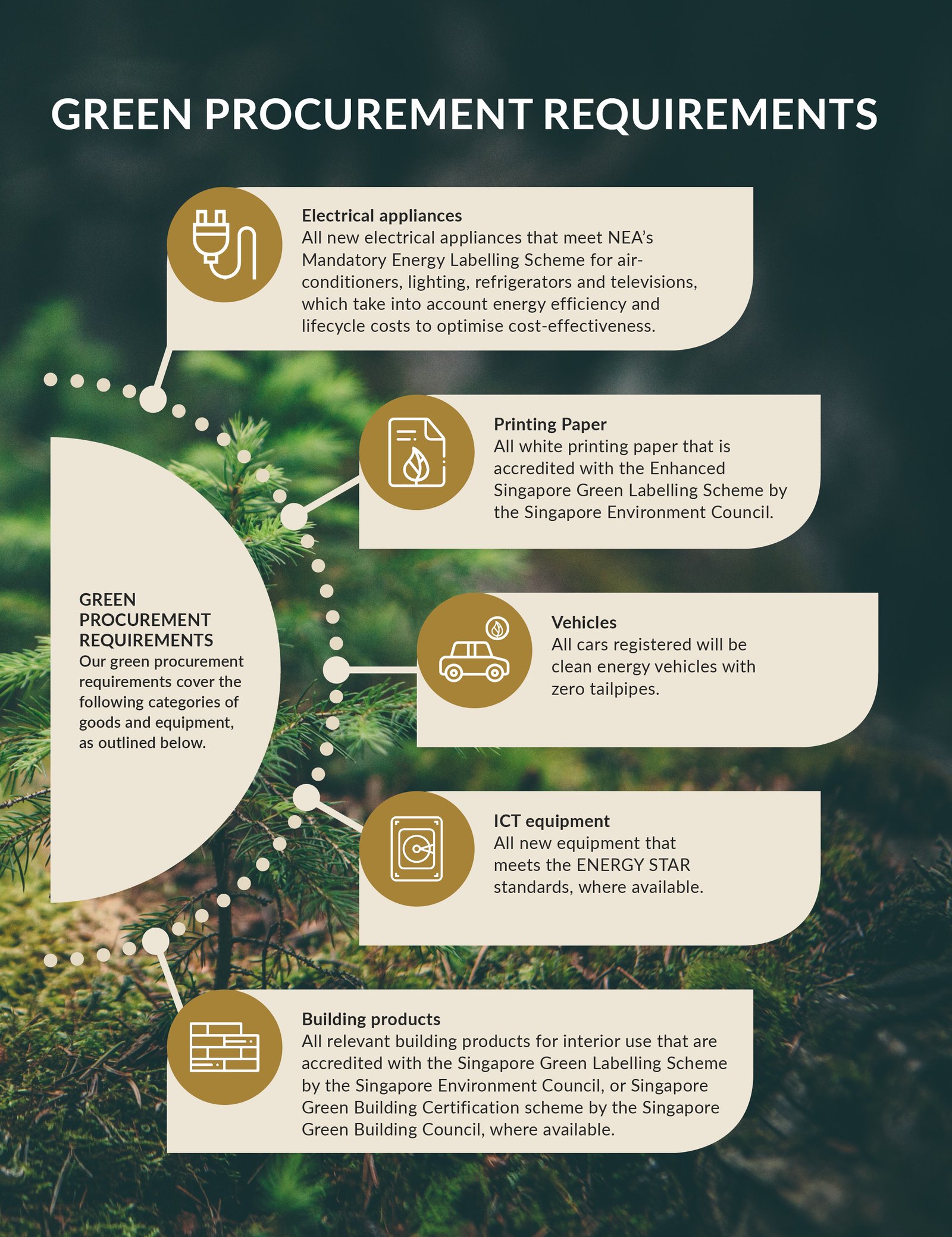
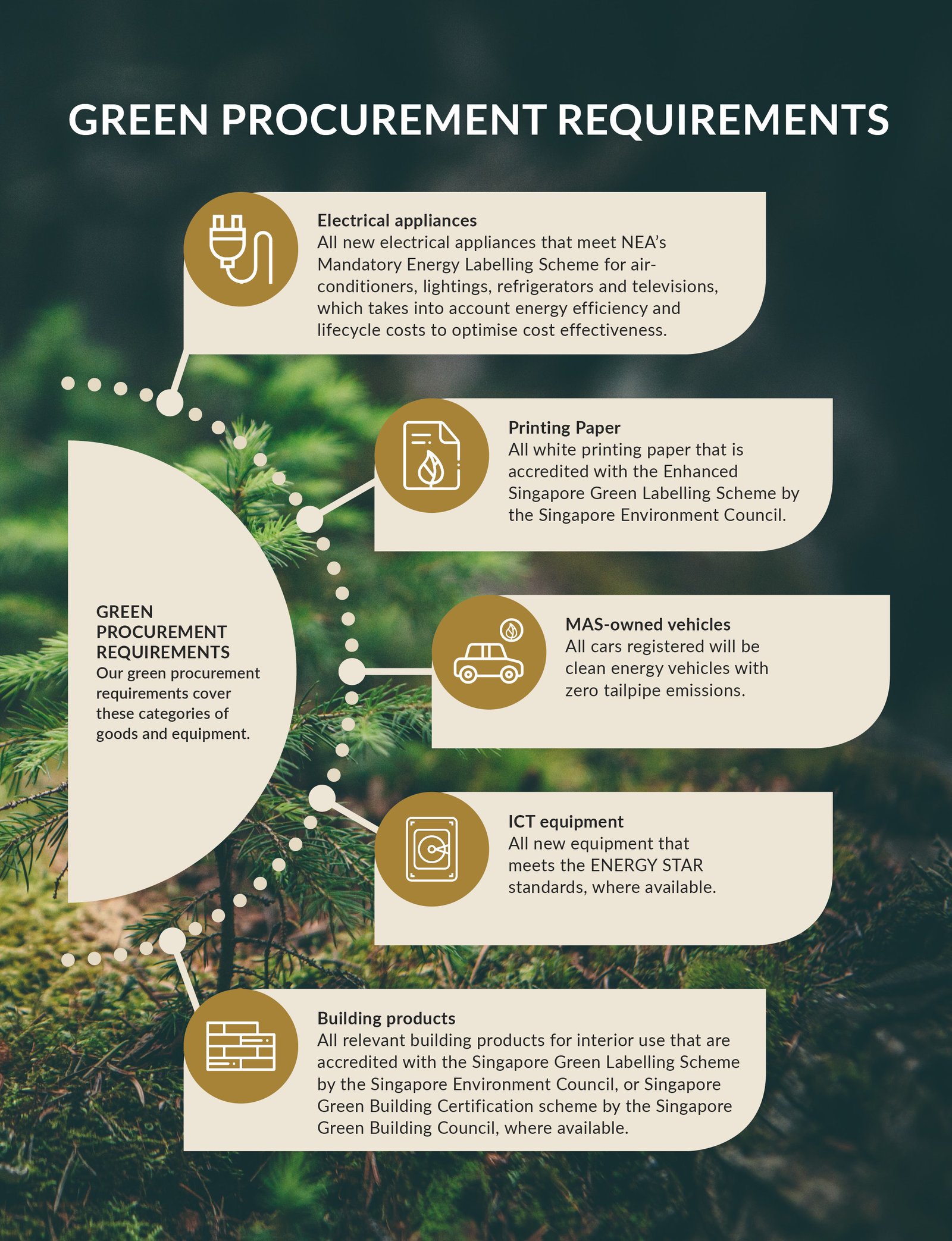
IHCC has factored green requirements in our procurement.
- We adopt the green procurement requirements from the GreenGov.SG framework and other initiatives such as National Environment Agency’s (NEA) Guaranteed Energy Savings Performance contracting model. This contracting model optimises the chilled water system design and ensures efficient performance, comprehensive maintenance, and guaranteed savings over a typical period of five years.
- Our green procurement requirements cover the following categories of goods and equipment, as outlined below.
Download Green Procurement Infographic
Metrics & Targets
Environmental sustainability targets
MAS’ near-term targets for FY2025 and FY2030
- MAS’ near-term targets for Scope 1, Scope 2 and Scope 3 emissions reduction are set based on the Science Based Targets initiative (SBTi) methodology, which has been independently validated by KPMG Services Pte Ltd.
- MAS’ Scope 1, Scope 2 and Scope 3 (business air travel) near-term targets are aligned with the well below 2°C science-based pathway, and Scope 3 (outsourced currency operations) near-term targets are aligned with the 2°C science-based pathway.
| Scope | Targets |
| Scope 1, Scope 2 and Scope 3 (Business Air Travel) emissions |
By FY2025: Reduce by 17.5% By FY2030: Reduce by 30% |
| Scope 3 (Outsourced Currency Operations) emission |
By FY2025: Reduce by 10% By FY2030: Reduce by 20% |
The above targets use FY2018 (ending March 2019) as the base year.
GreenGov.SG’s targets by 2030
- Energy Utilisation Index: improve by 10% from 2018-2020 baseline
- Water Efficiency Index: improve by 10% from 2018-2020 baseline
- Waste Disposal Index: improve by 30% from 2022 baseline
Carbon footprint of IHCC’ corporate activities
IHCC will continue to measure and report our corporate emissions using the Greenhouse Gas (GHG) Protocol. Overall, our FY2021 emissions declined 39% from FY2018 baseline, given the substantial decline in business air travel due to the COVID-19 pandemic. This is an aberration.
Electricity, waste and water usage profile
IHCC will introduce new metrics to report our energy utilisation, water efficiency and waste disposal, in accordance with the GreenGov.SG targets. The metrics are computed as follows:
- Energy Utilisation Index (EUI): annual energy consumption divided by the total Gross Floor Area
- Water Efficiency Index (WEI): annual water consumption per day divided by the total number of occupants including visitors
- Waste Disposal Index (WDI): total amount of waste disposed per day divided by the total number of occupants including visitors