Overview
We identify, assess and manage climate-related risks; and invest in opportunities that can arise from the low carbon transition.
Climate change can create financial risks for companies and investors through two main drivers:

Physical Risks
that result from more frequent and intense
extreme weather events and shift in
climactic conditions
extreme weather events and shift in
climactic conditions

Transition Risks
that result from societal response
to mitigate climate change.
to mitigate climate change.
The impact of climate change is not only structural and long-term, but depends critically on how the future pathway unfolds. There are two uncertainties here: which future pathway the world sets itself on, and how that pathway affects financial assets. Building a climate-resilient investment portfolio requires a forward-looking approach that needs to be calibrated over multiple time horizons.
20 Years
Understanding the impact on portfolio returns across climate scenarios over the long-term. We adopt a 20-year time frame as the implications of low carbon transition pathways, or the non-linear escalation of physical climate impacts can only be fully examined over a long-term horizon, as well as updated continually as methodologies improve for modelling climate scenarios to asset prices.
3 to 5 Years
Positioning the portfolio according to shifts in the direction of the climate transition that can be observed in the medium-term. Trends over a 3 to 5-year period can indicate a change in the pace of transition and allow us to calibrate portfolio actions in line with the likely transition pathway and the attendant implications for portfolio returns and asset allocation decisions.
Now
Implementing portfolio actions in the near-term based on the solution set that is presently available in order to build internal capabilities and experience, with a view to scaling up these actions over time.
Climate Scenario Analysis
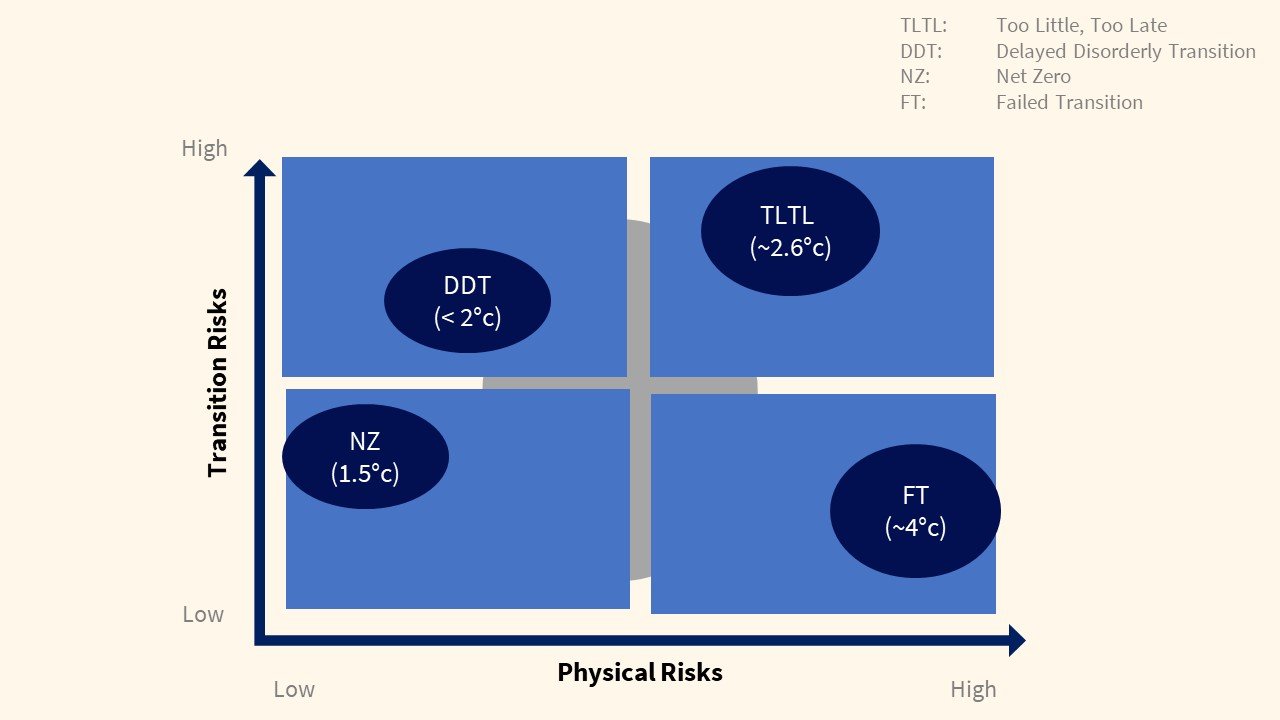
We continue to strengthen our study of the long-term impact of climate change as methodologies for climate scenario analysis mature. Scenario analysis allows us to understand the potential implications on long-term portfolio returns by setting out climate pathways involving different levels of transition and physical risks in various combinations and time scales. Our reference scenarios include:
Source: IHCC and NGFS
Portfolio Actions
Drawing from the findings of the climate scenario analysis, we developed a set of targeted portfolio actions, starting with transition risk in the equities portfolio. Collectively, these actions seek to enhance the climate resilience of the portfolio. We estimate that the portfolio actions that we implement over time will contribute to reducing the WACI of our equities portfolio by up to 50% by FY2030.
These actions include:
- Defining stewardship principles for our external managers to engage portfolio companies on climate-risk issues and to support their transition.
- Piloting two climate benchmarks to tilt equities investments towards companies that are better prepared for the transition to a low carbon future.
- Developing investment strategies that are focused on sustainability and climate change themes.
- Excluding investments in companies that are most vulnerable in a low-carbon transition, which for now we have scoped to those that derive more than 10% of their revenues from thermal coal mining and oil sands activities.
Our portfolio actions therefore seek to manage transition risks and benefit from low-carbon opportunities in different ways, given the current nascent developments around corporate disclosures, taxonomies, standards, methodologies and regulations.
Employing a wider range of portfolio actions will enable IHCC to influence real world emissions reduction of companies in the portfolio through our fund managers, invest more actively in transition opportunities and climate solutions, maintain flexibility to effectively reduce portfolio emissions and transition risk exposures when needed and, as a last resort, avoid assets vulnerable to becoming stranded in a swift, low-carbon transition.
The actions we take will grow and evolve over time with better data and techniques and as the imminence and clarity about physical and transition risks increase.
Portfolio Carbon Metrics
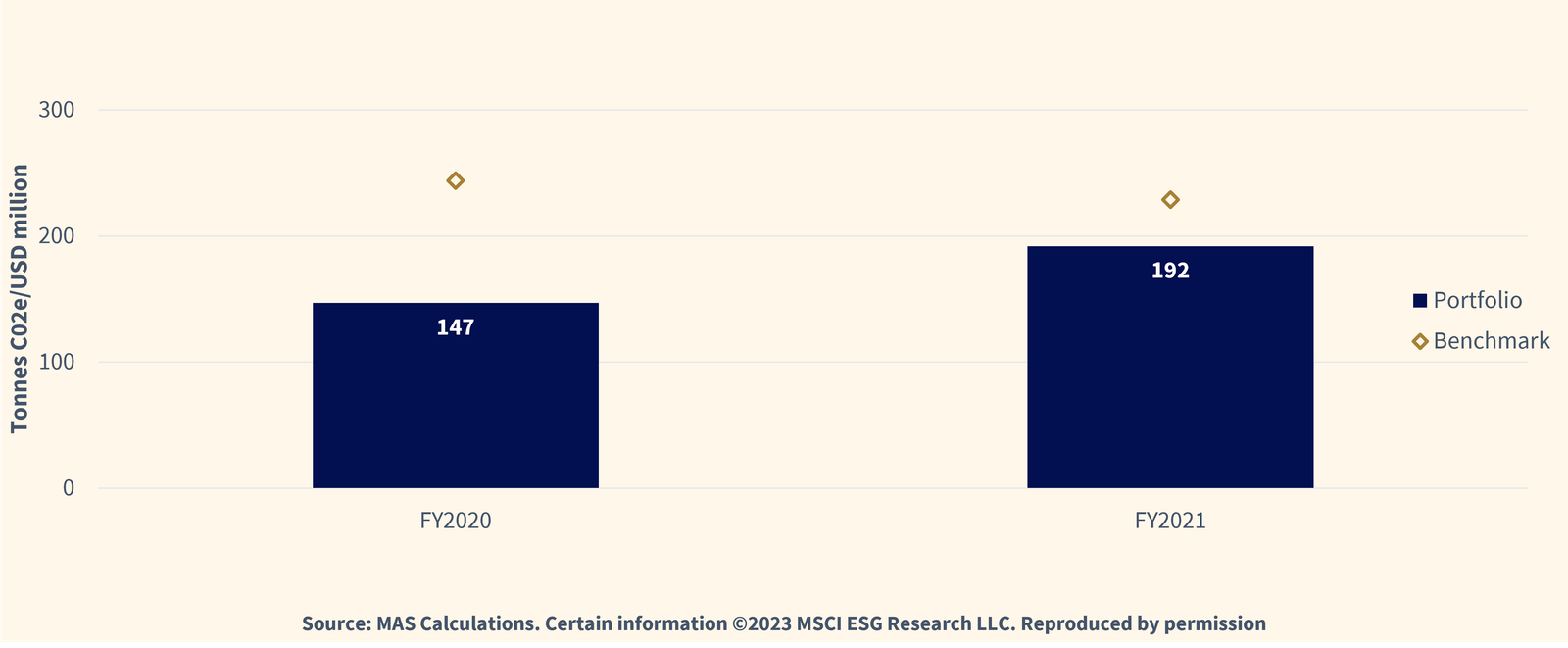
We measure the Weighted Average Carbon Intensity (Scope 1 and 2 emissions) of the equities and corporate bonds portfolios to gauge the level of transition risks and monitor the effectiveness of the portfolio actions that have been implemented.
Chart: Equities Portfolio WACI (in tonnes CO2e/ USD million of revenues)
Chart: Corporate Bonds Portfolio WACI (in tonnes CO2e/USD million of revenues)
We continue to monitor the development and explore the use of forward-looking metrics that can be incorporated into portfolio analysis and actions.